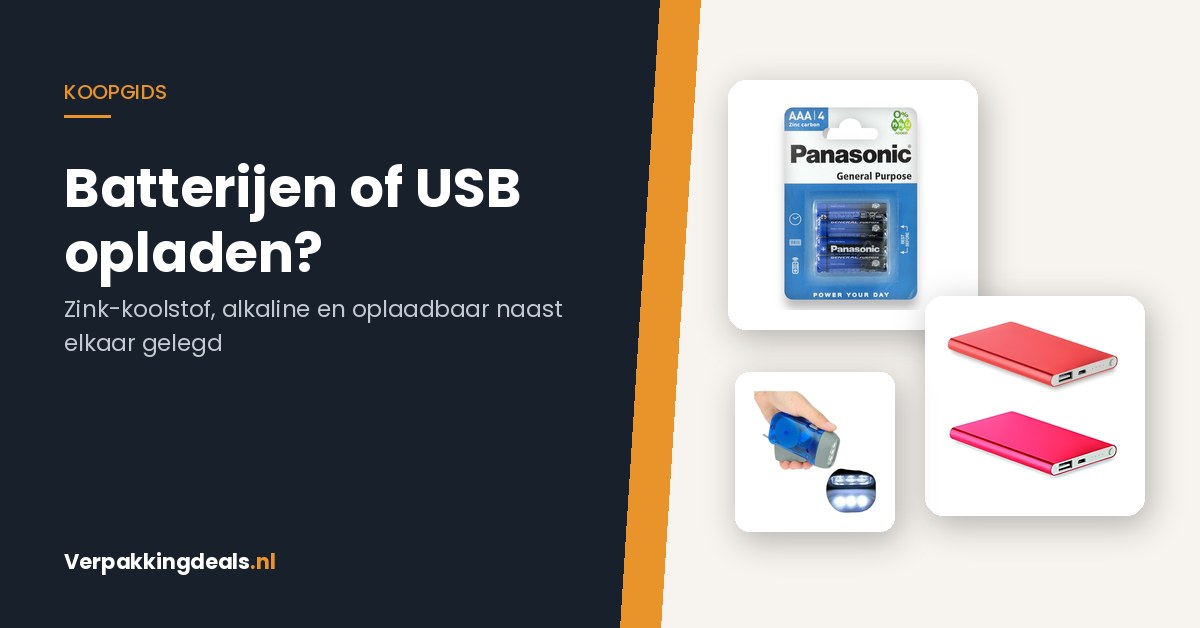
Batteries or USB charging? Zinc-carbon, alkaline, and rechargeable batteries compared
,
by Verpakkingdeals.nl
5 min reading time
Why does one AAA battery die in two days while another lasts for months? A clear explanation of zinc-carbon, alkaline, and rechargeable batteries, and when it's better to choose USB.
You put four fresh AAA batteries in a toy car and two days later it stops working. Those same batteries have been in your remote control for a year and a half and are still going strong. That's not bad luck or a bad battery—it's the wrong combination of battery type and device.
It's worth understanding the difference once, especially now that the darker months are approaching and lights, flashlights, and toys that have been dormant for months are coming out of the closet.
Zinc-carbon: cheap, and that's okay
Many inexpensive batteries are labeled zinc carbon or general purpose. That's the simplest chemistry there is. They reliably deliver 1.5 volts, but they cannot deliver high current and their voltage drops faster as they age. They are fine for devices that don't demand much:
Anything with a motor, a bright light, or a speaker briefly demands a lot of power. Think of toy cars, power tools, a battery-operated bubble gun (€19.95) or a bright flashlight. A zinc-carbon battery will quickly drain in such devices, and alkaline or a rechargeable cell is more appropriate. If you still put the cheapest ones in, the device might seem broken when it's simply not getting enough power.
Alkaline and rechargeable: when to use which
Alkaline maintains its voltage better under higher loads and has more capacity. More expensive per unit, but in a demanding device, it lasts so much longer that it turns out cheaper per hour.
Rechargeable cells (usually NiMH) have a nominal voltage of 1.2 volts instead of 1.5 volts. Most devices don't notice this, but some sensitive electronics will display a "low battery" message sooner. On the other hand, you can charge them hundreds of times. Rule of thumb: if you use a device weekly, rechargeable pays for itself. If you use it twice a year, a disposable battery is more logical—rechargeable cells self-discharge when not in use.
Device
Best choice
Why
Remote control, clock
Zinc-carbon
Low power demand, years of use
Toy cars or talking toys
Alkaline or rechargeable
Motor briefly demands high current
Emergency flashlight
Alkaline, or no battery
Must work after months of inactivity
Daily used device
Rechargeable
Pays for itself within a few months
Phone, speaker, light
USB
No separate cells needed
USB is increasingly the answer
A growing number of devices that used to run on AA or AAA now charge via USB. This saves hassle but shifts the problem: you now need a cable and a power outlet. For on the go, a 3000 mAh power bank (€14.95) solves this—compact enough for a jacket pocket or bag.
Most battery damage does not occur during use, but during storage. Four habits that save a lot of trouble:
Remove batteries from devices you won't use for months. That Christmas light, that flashlight in the shed, that beach toy going into winter storage—dead cells left inside are the main cause of corroded contacts.
Do not mix types or brands in one device. An old cell next to a new one will drag the new one down and increase the chance of leakage.
Store them dry and at room temperature, in their original packaging or separate from metal objects. Loose cells in a drawer with keys is not a good idea.
Deposit dead batteries at a collection point in a store or at the recycling center. They do not belong in the general waste bin.
If you want to send batteries or accumulators, first check the conditions of your carrier: specific rules apply to batteries and these differ per type and destination.
And the cables?
If you switch to USB, wear and tear shifts to the cable. The point where the cable enters the plug kinks and breaks first. A set of cable protectors, 4 pieces (€1.95) costs almost nothing and significantly extends the life of a cable. Those who like to have everything on one power supply on their desk or in the kitchen should look at devices that combine this, such as the stereo speaker with phone holder, USB and AUX (€14.95).
In short
Need little power and rarely replaced? Zinc-carbon suffices. High power or daily use? Alkaline or rechargeable. Almost always near an outlet or charging point? Choose USB and keep a power bank handy. And remove cells from anything that spends the winter in the cupboard.
Not sure which type belongs in your device, or are you looking for larger quantities for a store, association or office? Email your question to info@verpakkingdeals.nl — mention the device and the quantity, and we will find the appropriate type.
Choosing a USB hub for working from home: 2.0 or 3.0, how many ports, and with switches
· 3 min reading time
Choosing a USB hub for working from home: 2.0 or 3.0, how many ports and with switchesYour desk needs three USB devices, but your laptop only has two ports. Or...
Power outages in autumn: emergency supplies you'll actually use
· 2 min reading time
Autumn Power Outages: Emergency Supplies You'll Actually Use October to December. Heating isn't in full swing yet, but the nights are getting long and cold. If a power outage strikes...
Choosing a power bank: capacity, charging speed, and weight compared
· 2 min reading time
Choosing a Power Bank: Capacity, Charging Speed, and Weight Compared Your phone dies when you're out and about. The classic emergency solution is a power bank. But what capacity do...