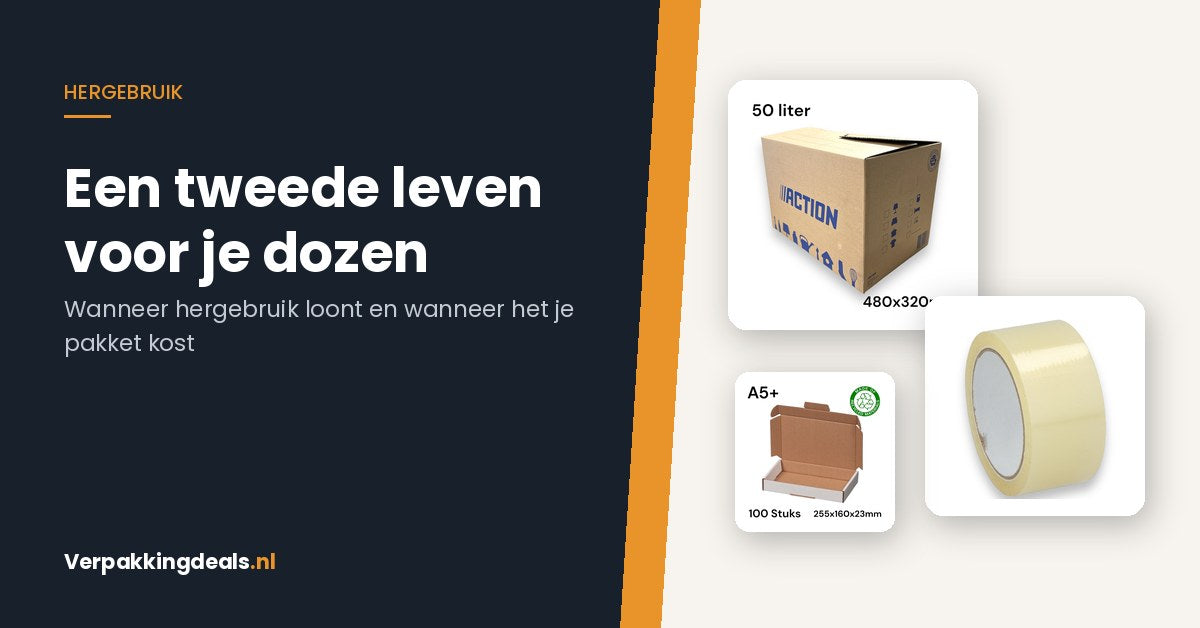
Reusing boxes in your webshop: when it's smart and when it's not
,
by Verpakkingdeals.nl
6 min reading time
Are you allowed to send used boxes to your customer? When reuse is sensible, what you should never reuse, and how to organize it neatly.
A stack is growing at the back of your warehouse. Boxes in which your own purchases arrived: too good to flatten, too messy to re-send without thinking. The question comes up for almost every small webshop at some point: can you use these boxes for your customer orders, and what does that do to your package and your brand?
The short answer: reuse is perfectly fine, provided you are selective. The long answer is about cardboard getting tired, about barcodes confusing scanners, and about what a customer sees when they receive a box from your supplier. Below is a workable guideline.
Why cardboard often doesn't make its second journey
Corrugated cardboard owes its strength to the wave between two flat layers. This wave flattens a bit with each journey: due to stacking pressure, opening with a knife, temperature changes, and especially moisture. A box that has been in a cold, damp delivery van once is measurably flimsier than a new one, even if it still looks neat.
This does not mean that every used box is unsuitable. It does mean that when reusing, you need to be stricter about what goes inside. A light, non-fragile order in a sturdy second-hand box is rarely a problem. The same cardboard under a heavy or fragile shipment is.
The ten-second check
Squeeze a corner. If the cardboard feels soft or fluffy, it has been damp: get rid of it.
Look at the edges. Dented or frayed edges mean the corrugation has already collapsed.
Check the flaps. Do they still close completely, or are they bulging?
Sniff. Anything that smells of food, cleaning products, or mustiness will transfer that smell to the contents.
Look for old tape. Layers of old tape over each other hold less well than one clean strip on bare cardboard.
What you definitely should not reuse
There are categories where discussion is unnecessary. Boxes from frozen or fresh products, boxes with holes or ventilation slots, boxes with a large logo of another brand, and anything with a damaged bottom seam. You also should not send a box that arrived as a return and is visibly damaged to the next customer. For these shipments, just use new cardboard: a Cardboard Shipping Box 15x15x15 cm - White (€ 1.99) or, for flat items, a bundle of Recycled Mailbox Box 255 x 160 x 28 mm (A5+), 100 pieces (€ 24.00).
Note that "recycled" and "reused" are two different things. Recycled cardboard is newly produced from old paper: it has its full strength and a clean exterior. If you want to purchase more sustainably without compromising on the shipment, that is the easiest knob to turn — for example, with the Recycled Mailbox Box 180 x 115 x 28 mm (A6), 100 pieces (€ 17.95).
Old labels are a technical problem, not a cosmetic one
Many startups underestimate this. A sorting center reads barcodes mechanically. If there is still an old shipping label on the box, there is a chance that the wrong code will be read and your package will take a journey you did not intend. Two labels on one box is therefore not sloppiness but a risk.
What your customer thinks (and how you manage that)
A reused box can go two ways. Without explanation, it reads as a cost-cutting measure: the customer sees your supplier's logo and thinks something is wrong. With explanation, it reads as a choice. One line on the packing slip or a sticker on the box — "this box is on its second journey" — completely changes the conversation. That costs you almost nothing and more often results in a compliment than a complaint.
To be fair: for gift shipments and high-end items, reuse is rarely smart. There, the unboxing experience contributes to what the customer pays for the product. So, split your flow: reuse for standard orders and shipments to business customers, new cardboard for gifts and anything sent as a present.
The calculation: what it really yields
Item
Effect of reuse
Box purchase
Saves approximately € 0.50 to € 2.00 per shipment
Labor
Costs extra time: sorting, removing labels, checking
Storage space
Used boxes are irregular in size and take up more space
Damage risk
Higher for heavy or fragile items; negligible for light and robust items
Customer perception
Positive if explained, negative if it seems accidental
Do the math for one evening with your own figures. For twenty shipments per week and a saving of one euro per box, you're talking about over a thousand euros per year — but only if sorting doesn't take you more than a few minutes a day. If it does, you'll earn more from one fixed box size that you buy in bundles.
Organizing reuse practically
The stack in the back doesn't work. What does work:
Sort upon arrival, not at the moment you need to ship. Approved boxes are flattened and sorted by size in a designated spot.
Limit yourself to two or three sizes that match your best-selling products. The rest goes directly to paper recycling.
Store flat and dry, not on the floor and not against an outer wall. Damp cardboard is lost cardboard.
Keep new material separate for gift shipments and fragile orders, so the choice is not dependent on the moment.
If you're sending something where the customer needs to see that the box remained sealed during transit, use a tamper-evident seal, such as Security Seal Stickers VOID (60 pieces, € 9.95). On a reused box, this is especially useful, as old tape marks can otherwise raise questions. And for storing your own inventory, rather than for shipping, an Action Moving Box 480x430x330 mm, 50 liters (€ 3.50) is often the cheapest solution.
Summary
Reuse boxes that are sturdy, dry, clean, and label-free for shipments that are not heavy or fragile — and explain it to your customer in one sentence. Use new or recycled cardboard for gifts, fragile items, and anything that needs to carry your brand. Never skimp on tape, void fill, and a clean address label: that's exactly where reuse goes wrong.
New and recycled boxes, tape, seals, and void fill can be found at Packaging & Shipping, Boxes, Mailbox Packaging and Tape. Would you like advice on which two or three box sizes best cover your assortment, or a price for larger quantities? Email info@verpakkingdeals.nl — we'd be happy to calculate it with you.
Choosing a USB hub for working from home: 2.0 or 3.0, how many ports, and with switches
· 3 min reading time
Choosing a USB hub for working from home: 2.0 or 3.0, how many ports and with switchesYour desk needs three USB devices, but your laptop only has two ports. Or...
Power outages in autumn: emergency supplies you'll actually use
· 2 min reading time
Autumn Power Outages: Emergency Supplies You'll Actually Use October to December. Heating isn't in full swing yet, but the nights are getting long and cold. If a power outage strikes...
Choosing a power bank: capacity, charging speed, and weight compared
· 2 min reading time
Choosing a Power Bank: Capacity, Charging Speed, and Weight Compared Your phone dies when you're out and about. The classic emergency solution is a power bank. But what capacity do...