Shipping the same package every month: how to standardize a subscription box
,
by Verpakkingdeals.nl
6 min reading time
A recurring shipment is the easiest to standardize: you know exactly what will be in it in advance. This way, you can select the correct box size, tape, and quarterly stock all at once.
You send the same thing every month: a box with a fixed content, to largely the same addresses. And yet, every month you find yourself puzzling. One time everything just fits into a smaller box, the next time you're buying tape halfway through the week because the roll ran out. With ten packages, you barely notice it. With a hundred, it costs you an entire evening.
A recurring shipment — a subscription box, a monthly reorder for a regular customer, a package you send to the same ten branches every month — is the easiest type of shipment to standardize. This is because you know exactly what will be in it beforehand. That's a luxury you never have with individual orders. Below is how to capitalize on that luxury.
Start with the contents, not the box
Most people choose a box first and then cram the contents in. With a fixed monthly shipment, it works the other way around. Lay out the complete contents of one box on the table, in the order the customer will unpack it. Only then measure: length, width, and stacked height.
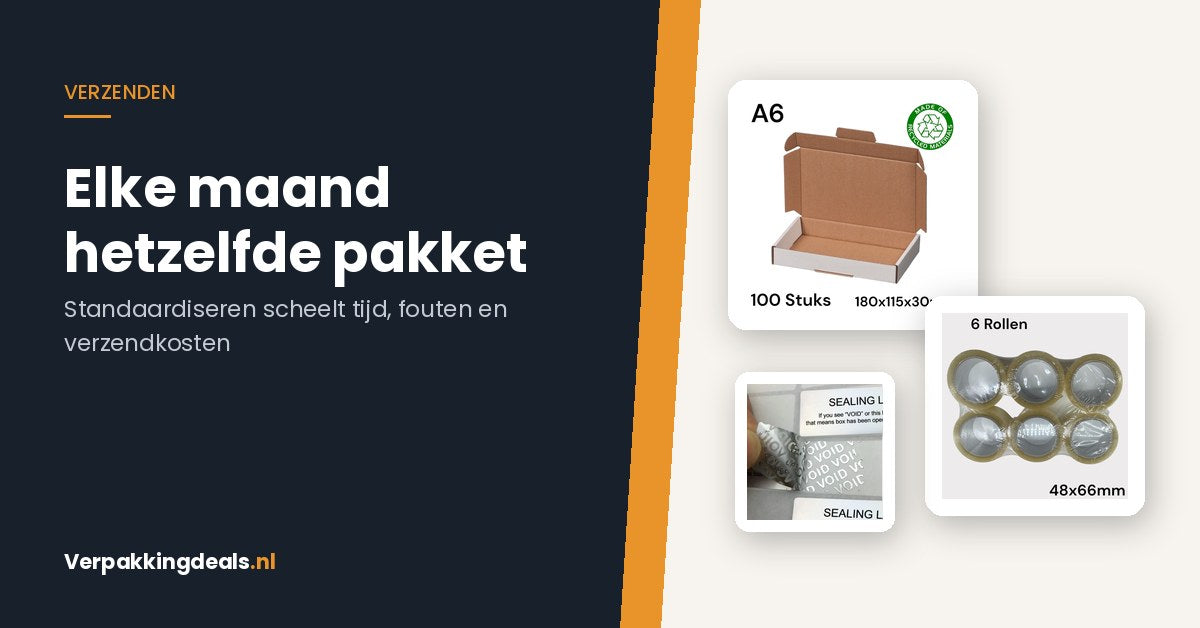
That height is the most important number you'll write down that day. If you stay below a few centimeters, your shipment can go out as letterbox mail, saving money and delivery attempts per package. Our recycled letterbox box of 180 x 115 x 28 mm (A6) is 28 millimeters high and costs €17.95 per bundle of 100 units. If you need a little more flat surface area, the A5+ version of 255 x 160 x 28 mm for €24.00 per 100 units is the logical step up. Same height, more length and width.
Please note: the maximum sizes for letterbox mail differ per carrier and change occasionally. Check the current dimensions and maximum weight with your carrier before purchasing a hundred boxes — PostNL, for example, publishes them on postnl.nl.
Doesn't it fit flat? Then choose one box size that fits the contents with a centimeter of leeway all around, and no more than that. A white cardboard shipping box of 15x15x15 cm costs €1.99 and is an excellent standard size for a compact box; for flat, wide contents, the black shipping box of 15x10x4 cm (€1.99) works better.
One box size, one tape type, one seal
The profit from a subscription box lies in repetition. Every choice you make once and then never again is time you get back every month.
One box size per box variant. Do you have a small and a large? Then two sizes, not five.
One dispenser per packing station. A tape dispenser with 2 rolls costs €9.95 and saves a few seconds of fiddling with each box.
One sealing method. If you want to make it visible whether a box has been opened en route, you can apply a VOID security seal over the seam; 60 pieces cost €9.95.
Write down these choices on one A4 sheet and hang it above your packing table. Not because you'll forget, but so the next person you bring in doesn't have to ask questions.
Calculate your monthly costs completely once
Because the content is fixed, with a subscription box you can do something that is almost impossible with individual orders: precisely calculate what packaging costs you per box. Add up what you use per package and divide the bundle prices by the quantity.
Item
Purchase
Per package
Letterbox box A6
€ 17.95 / 100 units
approx. € 0.18
Letterbox box A5+
€ 24.00 / 100 units
approx. € 0.24
Tape (6 rolls)
€ 21.00 / 6 rolls
a few cents per box
VOID seal
€ 9.95 / 60 units
approx. € 0.17
The figures per package are derived from the bundle prices above; how much tape you use per box depends on how many centimeters you pull and how many seams you seal. Do this calculation once a year, as both purchase prices and your own consumption shift.
Order quarterly, not monthly
A recurring shipment has predictable consumption, and that's precisely why reordering monthly is a waste. If you know you send 120 boxes a month, you need 360 boxes per quarter. That's four bundles of 100 with a small margin for misprints and damaged items. Expect about 3 to 5 percent spoilage and round up.
Flat cardboard takes up little space. A bundle of letterbox boxes lies unfolded on a shelf or under a table and only needs to be kept dry. Consider it as stock that you only need to order once a quarter, instead of something you put on your list every month. For larger quantities, check out the bulk packaging for webshops.
Protection: only where necessary
With a fixed box, you know exactly which component is fragile. Usually, it's just one: a jar, a bottle, a glass ampoule. The rest is textile, paper, or plastic that can easily survive a bump. So, don't wrap the entire contents, but only that one component.
For small, flat items, a bubble envelope of 22x17 cm for €0.90 is often sufficient — it then replaces the box altogether. If you're sending a box with one fragile item inside, you can cut a piece from a 500 mm wide bubble wrap roll (€12.95) to size. Make a cardboard template once, and you can cut the same size every month without thinking.
What you put in the box also counts
A recurring shipment is where an included note really pays off: you reach the same people every month. A bundle of white envelopes of 156x220 mm costs €3.00 per 500 pieces, and fits flat into almost any box. What goes in it — a packing slip, a card, next month's announcement — is up to you, but keep the size consistent so it always fits.
If you send something small and edible as an extra, mini pizza boxes of 85x85x20 mm (€10.00 per 100 pieces) are a convenient, flat container that will still fit in a letterbox box.
How to start this month
Pack one box as you normally would. Measure the contents, choose the box size that fits around it with minimal clearance, and immediately order a quarter's supply of it. Write down the four or five materials you will use from now on and place them within reach. From the second month, packing will no longer be a puzzle, but a routine.
Choosing a USB hub for working from home: 2.0 or 3.0, how many ports, and with switches
· 3 min reading time
Choosing a USB hub for working from home: 2.0 or 3.0, how many ports and with switchesYour desk needs three USB devices, but your laptop only has two ports. Or...
Power outages in autumn: emergency supplies you'll actually use
· 2 min reading time
Autumn Power Outages: Emergency Supplies You'll Actually Use October to December. Heating isn't in full swing yet, but the nights are getting long and cold. If a power outage strikes...
Choosing a power bank: capacity, charging speed, and weight compared
· 2 min reading time
Choosing a Power Bank: Capacity, Charging Speed, and Weight Compared Your phone dies when you're out and about. The classic emergency solution is a power bank. But what capacity do...