Shipping a bottle without breakage: box, protection, and the final check
,
by Verpakkingdeals.nl
5 min reading time
A bottle is heavy, fragile, and leaks if something goes wrong. Here's how to choose the right box size, protect the neck and base, prevent leaks, and check the package before you send it off.
A bottle is one of the trickiest things to ship. It's heavy for its size, usually made of glass, has a thin neck that's the first to break, and if it does break, it takes the rest of the shipment with it in the form of a wet, sticky box. With a broken cup, you have shards. With a broken bottle, you have shards AND a leak.
Nevertheless, a good number of bottles are shipped in autumn and December: oil and syrup from a webshop, a bottle as a gift to someone you don't see, filled bottles for a package or a baby shower. Below, we'll explain what typically goes wrong in practice and how to prevent it.
First measure, then choose a box
Most bottles break because they are in a box that isn't quite right. Too tight: the glass hits the wall, and every bump transfers directly. Too loose: the bottle shifts around and bangs against the cardboard from the inside.
Therefore, first measure your bottle — height including the cap, and the width at its thickest point. Add at least three to four centimeters of padding on all sides, and choose a box that fits around that. For small bottles up to about fourteen centimeters high, a compact box like the 15x15x15 cm cardboard shipping box (€1.99) works well. For longer bottles, you need a box that is at least ten centimeters longer than the bottle itself; if you're shipping several at once, a sturdy large box like the moving box of 480x430x330 mm (50 liters) (€3.50) is more convenient, provided you pack each bottle separately and fill the space in between.
Also pay attention to weight. A full one-liter bottle quickly weighs one and a half kilograms. Three of those in one box means a five-kilogram package resting on the bottom – so that bottom needs extra tape.
Packing in layers: neck, body, bottom
When it comes to a bottle, think of three weak points. The neck breaks with a side impact. The body breaks under pressure from above. The bottom is where the entire weight lands if the package falls upright.
A method that works well:
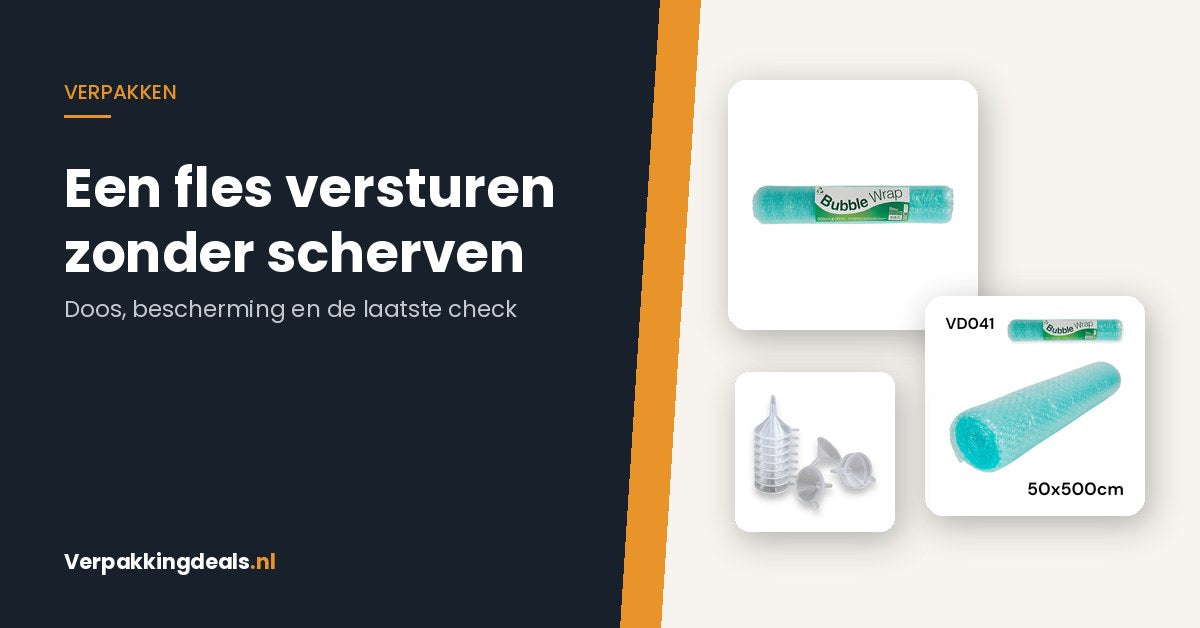
Wrap the bottle in bubble wrap for at least two turns, with an extra wrap around the neck and shoulder. A roll like the 500 mm x 500 m bubble wrap (€12.95) will last a long time if you ship regularly; for occasional use, a smaller roll of 50 x 500 cm bubble plastic (€5.00) will suffice.
Place the bottle upright in the box, not lying down. Upright, a fall is better distributed, and the cap stays above the liquid level.
Add an extra layer at the bottom. Two to three centimeters of padding at the bottom absorbs the most common fall: on the bottom.
Fill the sides completely until you can shake the box without anything moving. Movement is a sign that there's still room for damage.
Preventing leaks: the cap is not enough
A screw cap keeps liquid inside during normal use, not during pressure differences and stacking. So assume that the cap *can* leak and build a second layer around it.
In practical terms, this means: tighten the cap firmly, stick a strip of tape over it that extends down the neck on both sides, and then place the bottle in a sealed bag before wrapping it in bubble wrap. This way, any potential leakage stays within the bag instead of soaking into the cardboard. Those who frequently ship liquids can neatly seal these bags with a manual heat sealing machine (€79.95).
If you're sending small quantities — samples, trial sets, part of a larger bottle — pouring it into smaller containers is often smarter than sending the whole bottle. With empty 100 ml bottles (16 pieces) for €19.95 and a set of mini funnels (10 pieces) for €9.95, you can fill them neatly without spilling, and you'll immediately send a lighter, smaller package.
Taping, labeling, and sealing
Tape the box shut using the H-method: one strip over the center seam, and then a strip over both transverse seams on the top and bottom. For a heavy box, double-tape the bottom. Rolls like the tape of 48x66 mm in a set of 6 (€21.00) or individual KINZO packing tape of 50 meters x 48 mm (€3.00) are perfectly suitable for this.
Place the shipping label on a flat piece of cardboard, not over a seam or a foil edge—it will come off there. Remove old labels or cross them out if you're reusing a box. If you want to be able to see if someone has opened the box en route, stick a VOID security seal (60 pieces) (€9.95) over the closing seam.
One more point: carriers have their own rules for what you can and cannot send, and liquids and alcohol often fall under separate conditions. Before shipping, check what your carrier allows — PostNL has an overview of prohibited goods and substances for this. When in doubt: a quick call is faster than a rejected shipment.
The final check before you drop it off
Three actions, thirty seconds:
Shake. Do you hear or feel movement? Then there's still space.
Turn it upside down. Not for long, but just for a moment. If the bottle sinks or you hear something shifting, the bottom padding is too thin.
Place it on its corner. Let the box drop from about ten centimeters onto a corner. What doesn't survive that won't survive the sorting belt either.
Those who regularly ship bottles notice that the number of damage reports primarily decreases due to two things: consistently packing upright and always putting the bottle in a sealed bag. The rest is refinement.
Choosing a USB hub for working from home: 2.0 or 3.0, how many ports, and with switches
· 3 min reading time
Choosing a USB hub for working from home: 2.0 or 3.0, how many ports and with switchesYour desk needs three USB devices, but your laptop only has two ports. Or...
Power outages in autumn: emergency supplies you'll actually use
· 2 min reading time
Autumn Power Outages: Emergency Supplies You'll Actually Use October to December. Heating isn't in full swing yet, but the nights are getting long and cold. If a power outage strikes...
Choosing a power bank: capacity, charging speed, and weight compared
· 2 min reading time
Choosing a Power Bank: Capacity, Charging Speed, and Weight Compared Your phone dies when you're out and about. The classic emergency solution is a power bank. But what capacity do...