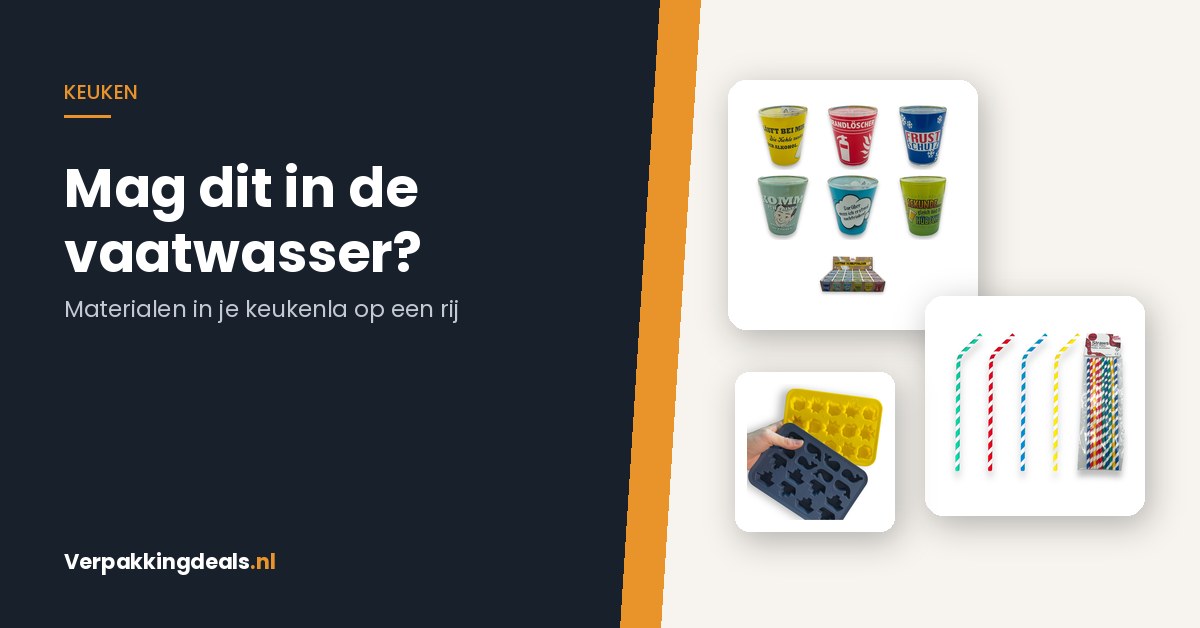
Can this go in the dishwasher? A guide to kitchen drawer materials
,
by Verpakkingdeals.nl
6 min reading time
Dull cups, warped lids, and chipped paint: almost always something went into a cycle that couldn't handle it. What happens per material and what to look for when buying.
That cup that has become dull and milky after six months. The lid that no longer closes because it has warped slightly. The opener whose paint has peeled off. Almost always the same thing has happened: something went into a hot dishwasher program that it couldn't withstand.
The dishwasher is not a gentle environment. The water is hotter than you could bear with your hands, the dishwashing detergent is strongly alkaline, and the drying program blasts another dose of heat. That's fine for plates and cutlery, and destructive for everything else that happens to be in there. Below, by material, is what happens and what to look for when buying.
First: where to find the symbol
On packaging and sometimes on the bottom of the product, there is an icon with a plate or glass and a few water droplets or diagonal lines. This indicates the manufacturer's statement about machine washing. If nothing is stated, it's not a guarantee in either direction: it only means that the manufacturer has not made a statement about it. When in doubt, hand washing is always the safe choice — and for thin or printed materials, it takes thirty seconds and saves you from buying a new one.
Two issues that go wrong more often than the material itself:
Position. The bottom rack is closer to the heating element and gets hotter than the top rack. Anything light and plastic belongs on top.
Program. An eco or glass program runs at a lower temperature than an intensive program. For delicate items, that makes all the difference.
Glass, ceramic, and porcelain: usually the sturdiest choice
Unprinted glass and glazed porcelain are best able to withstand repeated machine washing. What can happen is 'etching': a dull haze that appears after dozens of washes. This is usually a combination of hard water and too much detergent, not the glass itself.
What to look for when buying: how thin the rim is, and whether anything is printed on rather than under the glaze. A Shot Glass Set 6 pieces - 60 ml (€ 3.00) with a smooth, unprinted wall will survive a party and the subsequent washing without problems. For a mug with a thermal effect, such as the Ceramic Mug Thermal Effect Happy New Year 470 ml (€ 5.00), the function is in a coating layer — it's worth reading the manufacturer's instructions before putting it in the machine. The same applies to decorative glassware with a print, such as the Halloween Skeleton Glasses (€ 9.95).
Plastic: where most losses occur
Hard plastic and PVC behave unpredictably with heat. Thin material can deform, causing a lid or screw cap to no longer fit — and a cup that no longer seals is a cup you throw away. Additionally, odors and dyes adhere more easily to plastic than to glass.
The practical rule: plastic on the top rack, on a low program, and separate, flat lids. For a Sports and Coffee Cup Hard PVC 500 ml (€ 9.95) or a Water Bottle with Time Marker 2 liter (€ 24.95), that's the difference between years of use and one summer. Printing on the outside — such as the time marker on such a bottle — also wears out faster in the machine than with hand washing.
Parts with a pump, nozzle, or spout are a separate category. An Oil Bottle with Spray 300 ml (€ 9.95), the Space Gun Ketchup and Mustard Dispenser (€ 17.95) or the Juice, Syrup, and Honey Dispenser (€ 19.95) have springs, rings, and narrow channels. These do not get enough flow in the machine and can leak due to heat. Disassemble them, rinse them with warm water, and let them dry upright. A set of Mini Funnels (€ 9.95) helps with refilling without spills.
Silicone: the easiest material in your drawer
Silicone is flexible, does not deform at normal dishwasher temperatures, and releases more easily than most other materials. For ice and baking molds, that's exactly why it's popular. An Ice Cube Tray (€ 4.95), the Round Ice Cube Tray with Lid - 33 pieces (€ 7.95) or the Silicone Ice Mold Shot Glasses 4-piece (€ 8.95) are easily cleaned with warm water and detergent.
Two caveats: silicone absorbs odors if you put fatty or strongly scented ingredients in it, and it's light, so it can flip over in the machine and fill with water. Clamp it between other dishes. For larger quantities of ice, an Ice Ball Maker for Round Ice Balls (€ 1.95) is a cheap alternative for variety.
Metal, cast resin, and painted material
Stainless steel can generally go in fine, but watch out for combinations: if steel and aluminum lie against each other, stains can occur. Painted or enameled metal, such as a Metal Plate (€ 19.95), retains its print longest with hand washing.
Cast resin — often called polyresin — is found in decorative openers and handles, such as the Bottle Opener with Magnet Polyresin 12.5 cm (€ 9.95). This material is painted and varnished, and often glued to a metal part. Rinsing and drying by hand is the way to go here; the machine is not.
Paper and cardboard: intentionally single-use
Paper straws and cups are not meant to last. That's not a flaw but the idea: they are used once and then disposed of. Flexible Colored Paper Straws (€ 1.95) and Pastel Paper Straws (€ 1.95) are fine for a birthday; if you want them to stay in the glass longer, Multicolor Plastic Straws (€ 6.95) are sturdier. For larger groups, Coffee Cups 150ml 100 Pieces (€ 14.95) are the sensible choice: no washing up, but waste.
How to buy items that last
Material
What to look for
Advice
Glass and porcelain
Thin rims, printed design
Bottom rack, normal program
Hard plastic / PVC
Lids, screw threads, printing
Top rack, low program
Silicone
Odor absorption, flipping over in machine
Secure or hand wash
Parts with pump or spout
Springs and narrow channels
Disassemble, hand wash
Polyresin and painted metal
Lacquer, glue, paint
Rinse and dry
Paper and cardboard
Not applicable
Single-use
And one final remark about storage: a Storage Jar with Lid (€ 9.95) or a Milk Mug with Lid (€ 9.95) usually breaks at the lid, not the container itself. So treat the lid as the fragile part, and the whole thing will last for years.
Choosing a USB hub for working from home: 2.0 or 3.0, how many ports, and with switches
· 3 min reading time
Choosing a USB hub for working from home: 2.0 or 3.0, how many ports and with switchesYour desk needs three USB devices, but your laptop only has two ports. Or...
Power outages in autumn: emergency supplies you'll actually use
· 2 min reading time
Autumn Power Outages: Emergency Supplies You'll Actually Use October to December. Heating isn't in full swing yet, but the nights are getting long and cold. If a power outage strikes...
Choosing a power bank: capacity, charging speed, and weight compared
· 2 min reading time
Choosing a Power Bank: Capacity, Charging Speed, and Weight Compared Your phone dies when you're out and about. The classic emergency solution is a power bank. But what capacity do...