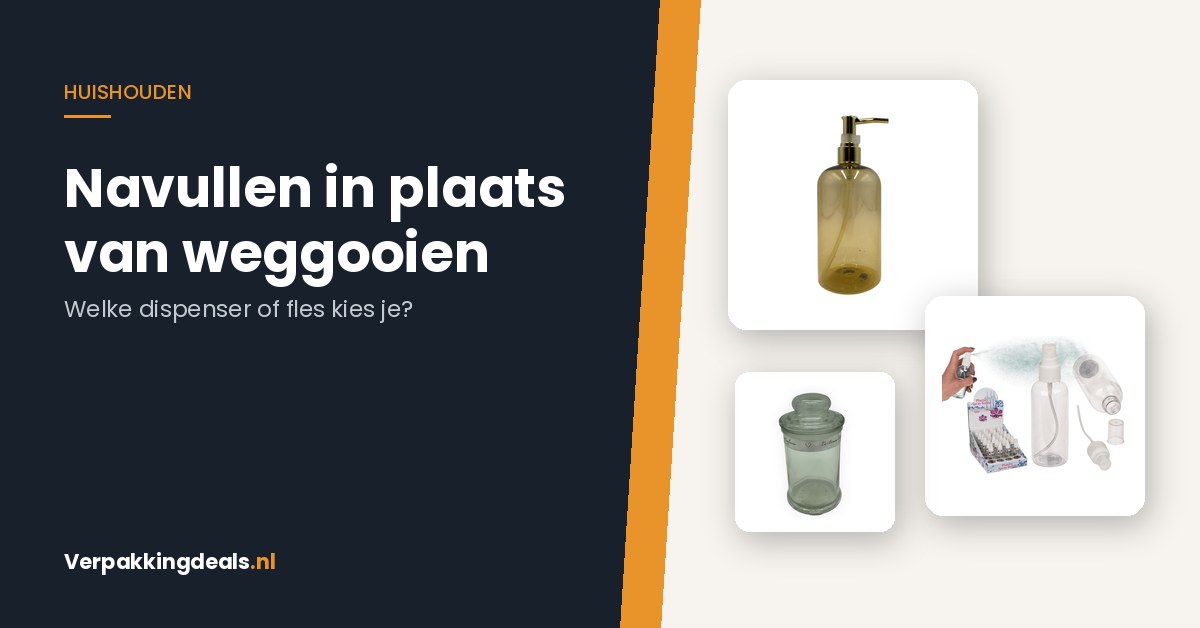
Refilling instead of throwing away: which dispenser or bottle do you choose?
,
by Verpakkingdeals.nl
5 min reading time
A large package costs a fraction per milliliter compared to individual bottles. Which container suits which product, glass or plastic, how do you pour without spilling, and what should you preferably not refill?
Most people have three half-empty bottles of the same product under the sink, each with its own pump that will soon end up in the plastic waste. This is not a matter of carelessness: packaging is designed this way. You always buy the bottle and the pump, while you only need the contents. If you reverse this — one good holder, bulk packaging for refilling — you pay significantly less per milliliter and throw away considerably less.
Below is what you need to make this practical, with a calculation example that shows where the difference lies.
Where refilling really saves money
Take disinfectant hand gel. A 100 ml bottle with 70% alcohol costs €2.95. To get five liters, you need fifty of them: €147.50. The same five liters can be bought as a 5-liter jerrycan for €14.95. You will need something to put it in, but that is a one-time purchase.
This pattern applies more broadly: soap, all-purpose cleaner, oil, syrup. Bulk packaging is almost always the cheapest unit, and the bottleneck is not the price but the question of what to put it in and how to decant it without spilling.
Which holder suits which product
A pump is not just a pump. The type determines whether the product comes out well and whether the bottle gets clogged.
Product
Type of holder
Why
Liquid soap, shampoo
Regular pump dispenser
Thicker liquid, needs a wide spout
Foam soap
Foam pump
Mixes air through thin soap; does not work with thick soap
Glass is heavier, does not scratch, and does not absorb odors — pleasant for something that stays in the same spot for years. The amber glass spray bottle of 50 ml (€7.95) also has the advantage that the dark glass blocks light, which helps with light-sensitive contents.
Plastic is lighter and does not break, and that outweighs more than it seems once a bottle lands on a tiled floor or in a bag. The 120 ml refillable spray bottle costs €7.99, and the variant with a regular cap instead of an atomizer, the 120 ml refillable bottle, is €2.99.
If you are decanting multiple products at once — for a weekend bag, a guest room, or to divide a bulk package — buying individually is a waste. The set of 16 empty 100 ml bottles costs €19.95, or just over a euro per bottle.
Decanting without spilling
The point where people give up is the decanting itself. Holding a five-liter jerrycan over a 100 ml bottle works once, and not the second time.
Two small aids solve this. A set of mini funnels, 10 pieces (€9.95) means you can keep a separate funnel for each product, so you don't have to rinse in between. For bottles you pour from instead of pump, pour spouts, 3 pieces (€4.95) keep the stream narrow and the rim dry.
Practical tip: decant over the sink, not over the countertop, and never fill completely to the brim — a pump displaces volume and will otherwise push the contents back out.
What you should not refill
Refilling works well for soap, cleaners, oil, and dry goods. There are also cases where you shouldn't do it.
Do not mix residues of different products. They are not inherently compatible, and you won't know what's in it afterward.
Do not dilute anything with water unless the product is intended for it. Water is a breeding ground; a product not designed for it will not keep.
Refilling on top of existing product is not a good idea. Empty the holder, rinse and dry it, and only then refill.
Label anything that isn't immediately recognizable — especially cleaners, and especially if there are children in the house. Store cleaners separately from things you use on your skin.
A pump that becomes stiff usually isn't broken but clogged. Fifteen minutes in warm water and pumping through helps in most cases.
The final gain: off the floor
Refilling only really pays off if the holders also have a fixed place. Otherwise, the bulk packaging just gets in the way. A set of self-adhesive hooks of 6x6 cm, 10 pieces (€5.95) is the cheapest intervention for this: cloths, brushes, and spray bottles on the wall instead of on the floor of the cabinet. For the cleaning itself, a 150 ml surface cleaner (€3.95) is a handy size to keep nearby.
In short
Choose the right type of holder for each product, buy the contents in the largest packaging you will use within a year, use a funnel, and label it. You usually recoup the purchase cost within a few refills.
Choosing a USB hub for working from home: 2.0 or 3.0, how many ports, and with switches
· 3 min reading time
Choosing a USB hub for working from home: 2.0 or 3.0, how many ports and with switchesYour desk needs three USB devices, but your laptop only has two ports. Or...
Power outages in autumn: emergency supplies you'll actually use
· 2 min reading time
Autumn Power Outages: Emergency Supplies You'll Actually Use October to December. Heating isn't in full swing yet, but the nights are getting long and cold. If a power outage strikes...
Choosing a power bank: capacity, charging speed, and weight compared
· 2 min reading time
Choosing a Power Bank: Capacity, Charging Speed, and Weight Compared Your phone dies when you're out and about. The classic emergency solution is a power bank. But what capacity do...