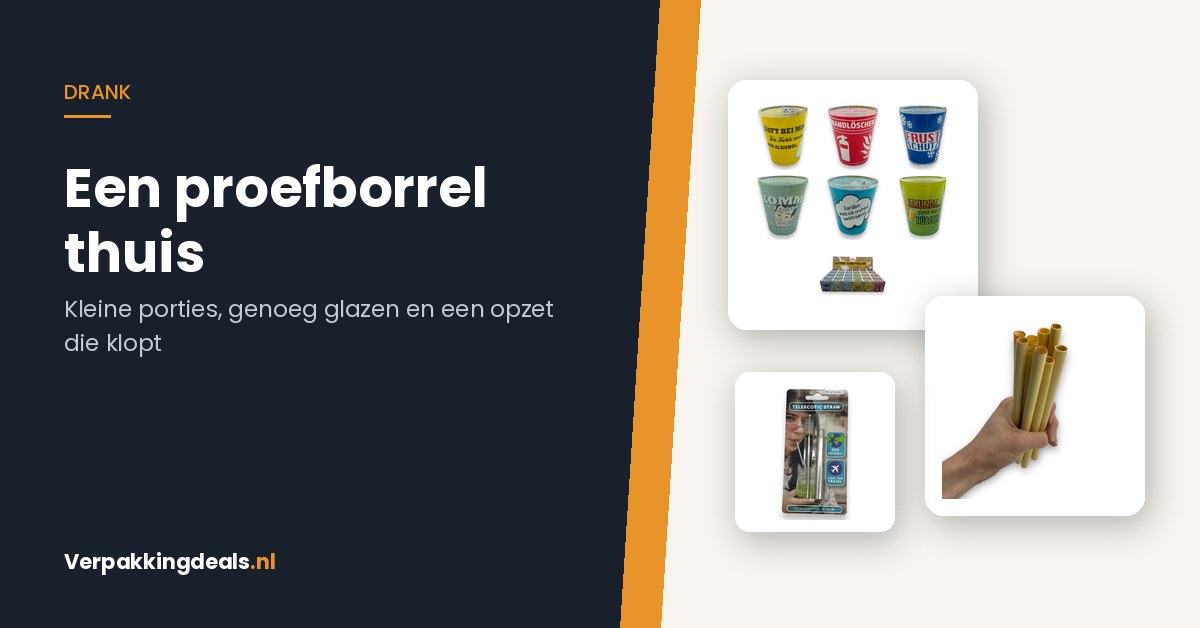
A tasting at home: small portions, enough glasses and a well-designed setup
,
by Verpakkingdeals.nl
5 min reading time
Tasting five drinks with six people requires small portions and more glasses than you might think. Here's how to calculate what you need and set up a tasting that doesn't get out of hand.
Six people, five bottles on the table, and six glasses in the cupboard. Halfway through the third round, half the company has a glass with a tiny bit of the previous drink left, and no one can agree on which one was the best. A tasting party doesn't depend on what you pour, but on how many glasses are on the table and how big the portions are.
It's ideally suited for the months when you're back indoors. You don't have to look far: four to six varieties of something — beer, non-alcoholic beers, gin, tea, coffee, sodas from the fair trade shop — and people who have opinions about them. Below is what you need and how to set it up.
Small portions are the whole idea
At a regular gathering, you pour a full glass and drink it. For a tasting, you do the opposite: you pour little, you smell, you take two sips, and you move on. Count on approximately 25 to 50 ml per person per variant. With five variants, that comes out to about 150 to 250 ml per person over the entire evening — less than two regular glasses.
This means that one bottle goes a long way, and small glasses are handier than large ones. A Shot Glass Set of 6 (60 ml) (€3.00) is exactly the right size for 25 to 50 ml to look good without the glass appearing empty. Two sets for six people are better than one, for the simple reason below.
Count your glasses by rounds, not by people
Most people buy glasses based on the number of guests. For a tasting, you should count by rounds. Anyone who uses the same glass between two variants will always taste a little of the previous one. That's fine — but then you have to rinse, and that takes time and a bucket of water on the table.
Two workable options:
Two glasses per person. One in use, one clean. Rinse in the kitchen in between while the rest continue talking.
One glass per variant per person. Everything is prepared beforehand, everyone can re-taste and compare. With five variants and six people, that's thirty glasses — which is why sets of six are cheaper than individual glasses.
For the second option, put a marker on each glass, otherwise the order will get lost. Small wooden pegs work better than stickers on glass: the Decorative Wooden Heart Clips (10 pieces, €9.95) clip onto a piece of paper with a number, and they can be reused afterwards.
Ice: when to use it, when not to
For tasting, ice is usually a disadvantage. Cold drinks flatten the taste, and melting ice dilutes your portion. For the drinks you're seriously comparing, it's better to omit it or add it only in the second round — then you'll immediately taste the difference it makes.
If you do want ice, choose large blocks over small ones. Large blocks have less surface area and therefore melt slower. With the Ice Ball Maker (€1.95) you can make exactly these large spheres; for a larger stock at once, the Round Ice Cube Tray with Lid for 33 pieces (€7.95) is more practical — with a lid, so your mold doesn't taste like the freezer.
A little extra for in between: with the Silicone Ice Shot Glass Mold (4-piece, €8.95) you freeze ice glasses. Fun for one round, not for the comparison itself.
Water, snacks, and pacing
Put two things on the table that are always a must. Water, for rinsing and drinking in between — a pitcher or large bottle on the table saves you getting up ten times. A 2-liter water bottle with time markings (€24.95) is large enough for this, and you can see at a glance how much is left. And something neutral to nibble on: bread, crackers, or unsalted nuts. Store them in a storage jar with a lid (€9.95), so the rest stays good afterward.
Regarding the pace: plan forty-five minutes to an hour for four to six variants. Any faster and no one will taste anything, any slower and it becomes a regular evening with a spreadsheet. After each round, have everyone write down in one word what they thought of it, before the discussion. Otherwise, the loudest voice will dictate opinions to the rest.
Keeping cool without emptying your fridge
Five extra bottles often don't fit alongside that week's groceries. A 10-liter cooler bag (€9.95) next to the table solves that: your bottles stay cool, they're out of the way, and you don't have to go into the kitchen.
Also, make sure the opener is on the table and stays there. A magnetic bottle opener (€9.95) sticks to the fridge or a metal edge, so it doesn't disappear under the napkins halfway through the evening.
Straws: only for what goes in between
You don't use a straw for the tasting itself — you want to smell what you're drinking. For long drinks, iced tea, or soda afterward, you do. Paper straws are the cheapest but get soft after about ten minutes: the flexible paper straws of 220 x 6 mm cost €1.95 for 10 pieces. Bamboo straws of 20 cm (10 pieces, €2.99) remain sturdy and can be washed. For those who always carry one: the metal telescopic straws of 21.5 cm (€1.95) slide into a case.
The checklist for the evening itself
Four to six variants, two glasses per person or one per variant, water on the table, something neutral to eat, paper and pens, ice only if intentionally used, and an opener that stays put. That's all there is to it.
You can find glasses and straws in Glasses and Straws, ice and cooling equipment in Coolers & Ice Cubes, and openers in Openers. Are you organizing something like this for a larger group, a club, or a staff evening and need multiple sets of the same item? Send an email to info@verpakkingdeals.nl, and we'll look at quantities and stock.
Choosing a USB hub for working from home: 2.0 or 3.0, how many ports, and with switches
· 3 min reading time
Choosing a USB hub for working from home: 2.0 or 3.0, how many ports and with switchesYour desk needs three USB devices, but your laptop only has two ports. Or...
Power outages in autumn: emergency supplies you'll actually use
· 2 min reading time
Autumn Power Outages: Emergency Supplies You'll Actually Use October to December. Heating isn't in full swing yet, but the nights are getting long and cold. If a power outage strikes...
Choosing a power bank: capacity, charging speed, and weight compared
· 2 min reading time
Choosing a Power Bank: Capacity, Charging Speed, and Weight Compared Your phone dies when you're out and about. The classic emergency solution is a power bank. But what capacity do...