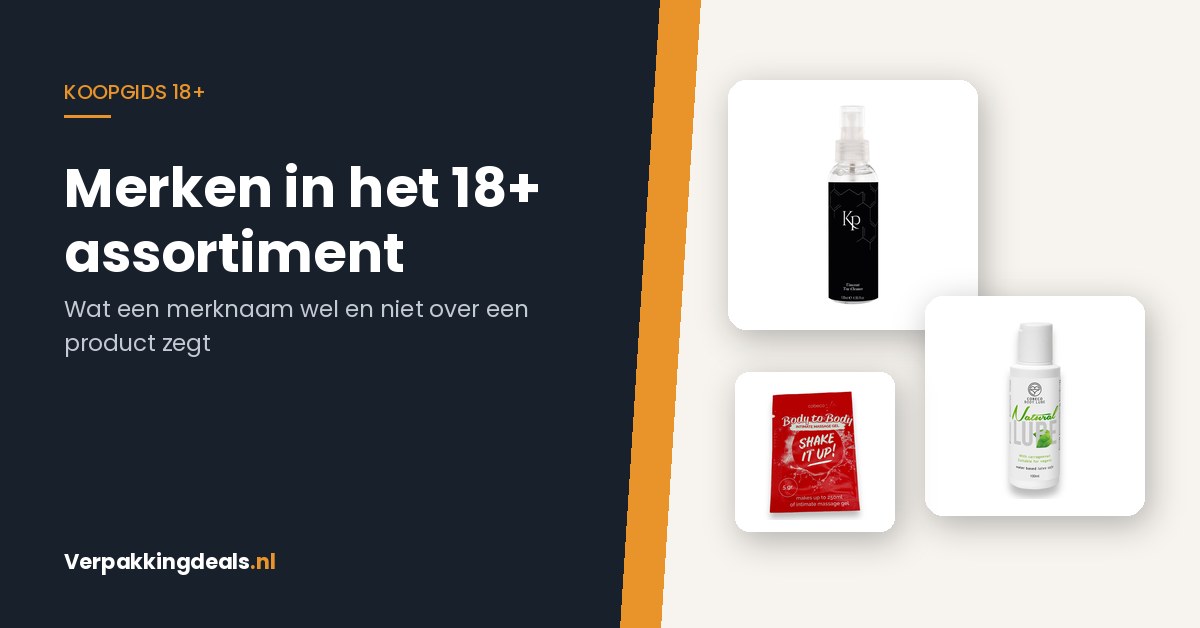
Brands in the 18+ range: what a brand name does and does not say
,
by Verpakkingdeals.nl
5 min reading time
Three bottles next to each other with different brand names: does that tell you anything? A brand name tells you where you are in the range and whether a line connects, but nothing about material, size, sound, or sturdiness.
You're looking for a lubricant, and there are three bottles next to each other with different brand names on them. Almost the same content, almost the same price. The question that arises is reasonable: does such a brand name actually mean anything, or is it mainly just a label on an otherwise identical product?
The answer lies somewhere in between. A brand name tells you a few concrete things you can use in your choice. And it tells you a few things it doesn't, which you might easily overlook. Below, we list both, with examples from our own 18+ assortment.
That's useful information. Anyone looking for a bottle can skip the device brands and vice versa.
2. Whether a line is internally consistent
Within one brand, you often see the same design in multiple sizes or colors. The bondage tape black 15 meters and the bondage tape red 15 meters (both € 14.99) are the same roll in a different color. Handy if you want to reorder later or use two colors side by side: you know that the length and design are the same.
3. How the product arrives at your home
Brands package in their own way. Some items come in a sealed box with specifications on the back, others in a simple bag or a blister card. This determines whether the product is gift-ready and whether you can read the storage instructions later. If you see a photo of a box on the product page, that's usually what you'll get.
Material is in the product description, not in the brand name. Two items from the same brand can be made of different materials. If you want to know what you're dealing with, read the description and the packaging — and adjust your lubricant and cleaning accordingly.
Not: that sizes are comparable between brands
A designation like "20 x 8 cm" is a product size, not a brand standard. For each item, go by the specified centimeters rather than your experience with another item of the same name.
Not: how quiet, how heavy, or how sturdy something is
What a brand doesn't put in the specifications isn't there. Sound, weight, and hardness vary per model. The Kitty Smiley vibrating egg with remote control (€ 9.50) and a larger motor from the same brand are simply not the same item in those respects.
How to use this when making a purchase
A workable sequence if you're torn between two similar products:
First, determine the category and size. What kind of item are you looking for, and what dimensions fit? Only then do you look at brands.
Read the specifications, not the name. Material, dimensions, content in ml or grams, power source, included parts.
Calculate per unit. For liquids, the price per 100 ml is fairer than the price per bottle.
See if there's a complementary product from the same brand. Cleaner, refill, second color: that saves searching for a subsequent order.
Stick with one brand if something was satisfactory. Not because the brand is better, but because you then know what you're getting in terms of execution and packaging.
A brief comparison
Question
Look at
Does this fit me in terms of size?
The centimeters in the title and description
How do I clean it?
The material in the description
Do I get anything extra?
The set contents on the product page
Can I reorder it later?
Whether the brand offers more variations
Is it suitable as a gift?
The photo of the packaging
In short
A brand name is a useful filter: it tells you which part of the assortment you're in, whether there's a line you can supplement later, and what kind of packaging something comes in. It tells you nothing about material, sizing compared to other brands, sound, or sturdiness. That information is in the specifications of the individual item — and that's ultimately what you base your choice on.
Choosing a USB hub for working from home: 2.0 or 3.0, how many ports, and with switches
· 3 min reading time
Choosing a USB hub for working from home: 2.0 or 3.0, how many ports and with switchesYour desk needs three USB devices, but your laptop only has two ports. Or...
Power outages in autumn: emergency supplies you'll actually use
· 2 min reading time
Autumn Power Outages: Emergency Supplies You'll Actually Use October to December. Heating isn't in full swing yet, but the nights are getting long and cold. If a power outage strikes...
Choosing a power bank: capacity, charging speed, and weight compared
· 2 min reading time
Choosing a Power Bank: Capacity, Charging Speed, and Weight Compared Your phone dies when you're out and about. The classic emergency solution is a power bank. But what capacity do...