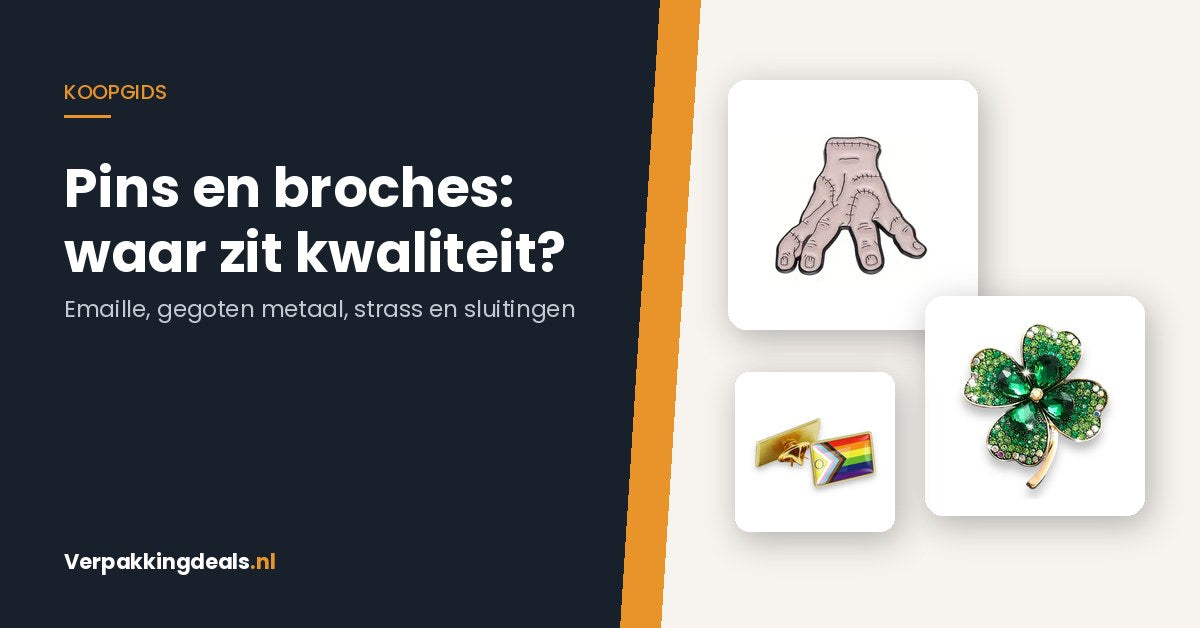
Enamel, cast, or rhinestone? How to spot quality in pins and brooches
,
by Verpakkingdeals.nl
6 min reading time
What's the difference between a pin that still looks good after a year and one that becomes dull or disappears? About enamel, cast metal, rhinestones, clasps, and price per piece.
Two pins of the same size, both around eight euros, yet after six months on your jacket, one still looks new while the other's color has dulled and the pin has disappeared into the washing machine. This difference is rarely in the design. It's in the metal, the finish of the colored surface, and especially in the clasp on the back — precisely the things you can judge least effectively from a product photo.
Below, we've listed what you should really look for in pins, badges, buttons, and brooches, so you know what you're buying before it's on your jacket.
Enamel, cast metal, and printed: three ways to get color on metal
Almost all metal pins start the same: a cast or stamped basic metal shape, usually gilded, silver-plated, or black finished. The difference arises with the color.
Enamel in raised compartments. The color is applied into recessed compartments, with the metal edges in between acting as lines. You can feel these edges if you run your nail over the surface. This creates sharp separations between colors and a surface that doesn't easily wear through. The Enamel Pin Creepy Hand (€7.95) and the Metal Pin Watermelon Enamel (€7.95) are examples where the pattern is composed of separate color fields.
Flat-ground enamel. The same technique, but the entire piece is smoothly finished so that metal and color are flush. Feels sleeker, usually costs a bit more.
Printed under a lacquer layer. The image is printed and covered. This allows for color transitions and fine details that are not possible with enamel. Disadvantage: it depends entirely on that protective layer.
None of these three is inherently better. A design with many small details requires the printing method; a graphic design with flat colors will look better in enamel. What you DO want to know: how fine are the lines in the photo, and how big is the pin in reality? A detail of one millimeter on a 2.5 cm pin, like with the Four-Leaf Clover Metal Pin of 2.5 cm (€7.95), reads differently than the same detail on a product photo magnified ten times.
The clasp determines if you'll see it again
This is the part most people don't look at, and where most pins get lost. Roughly, you'll encounter three types.
The butterfly clutch — the metal clip with two wings — is by far the most commonly used and comes standard with most pins. It works fine, but it can come loose if it snags on something: a bag over your shoulder, a seatbelt, a jacket over a chair back. For something you wear often, a rubber cap or a screw-on clasp is worth considering as a replacement.
With a button with a safety pin, the pin is integrated into the back. This is the cheapest construction and perfectly fine for one evening — think of the Bachelor Party Buttons, 6 pieces (€4.95) — but not something you want to have on the same jacket for years.
Practical rule: the heavier and wider the pin, the more it relies on a single attachment point. Something wide with one pin in the middle will tilt and hang crooked. Two pins or a brooch clasp prevents this.
What costs what, and where the price difference lies
In our assortment, prices generally range from €4.00 to €9.95 each. That's a small range, but the difference is noticeable.
For sets, pay attention to what you're getting: two pins for €9.95 is cheaper per piece than one pin for €7.95. And pay attention to rhinestones. Stones make a brooch more striking, but they are attached with glue. This isn't a problem as long as you don't put it in the washing machine or clean it with aggressive cleaners — but it is the reason a rhinestone brooch is more of a piece of jewelry than an everyday jacket pin.
Maintenance: short and simple
Metal with a colored layer needs little, but the right little. Remove pins from your jacket before it goes into the wash — that's by far the most important rule. Otherwise, wipe them with a dry or slightly damp cloth. Do not use abrasive cleaners, silver polish, or alcohol on printed pins: the print and lacquer layer are precisely the most vulnerable parts.
Don't store them loosely in a drawer where they can rub against each other. A box with compartments, a piece of felt, or a strip of fabric where you can pin them will prevent scratches. If you wear multiple at once, place them on a sturdy surface: a denim jacket, a bag, or a lanyard holds more weight than a thin T-shirt.
Are you selling them yourself? Think about the presentation
For stores, stalls, and associations: pins only sell themselves when they are at eye level and customers can pick them up. Loose in a bin on the counter, they get mixed up and the nicest ones disappear first. An Acrylic Transparent Stair Display with 6 steps (€34.95) or a metal display holder (€17.95) gives small items height, so you can display three times as much in the same square decimeter.
Also calculate your price point. For items between €4.00 and €9.95, your margin is in volume, not in individual sales. A display that sells five pins a day instead of two pays for itself within a few weeks.
What to order
If you want to choose yourself: the complete range is in Pins & Badges, with specific selections in Badges – PRIDE and Badges – Halloween. If you're looking for something more jewelry-like, check out Jewelry & Watches. For presenting them in your store or at your stall, you'll find displays under Storage.
If you're unsure about a size, clasp, or quantity for a larger order, feel free to email info@verpakkingdeals.nl — we'd be happy to help before you order a hundred pieces.
Choosing a USB hub for working from home: 2.0 or 3.0, how many ports, and with switches
· 3 min reading time
Choosing a USB hub for working from home: 2.0 or 3.0, how many ports and with switchesYour desk needs three USB devices, but your laptop only has two ports. Or...
Power outages in autumn: emergency supplies you'll actually use
· 2 min reading time
Autumn Power Outages: Emergency Supplies You'll Actually Use October to December. Heating isn't in full swing yet, but the nights are getting long and cold. If a power outage strikes...
Choosing a power bank: capacity, charging speed, and weight compared
· 2 min reading time
Choosing a Power Bank: Capacity, Charging Speed, and Weight Compared Your phone dies when you're out and about. The classic emergency solution is a power bank. But what capacity do...