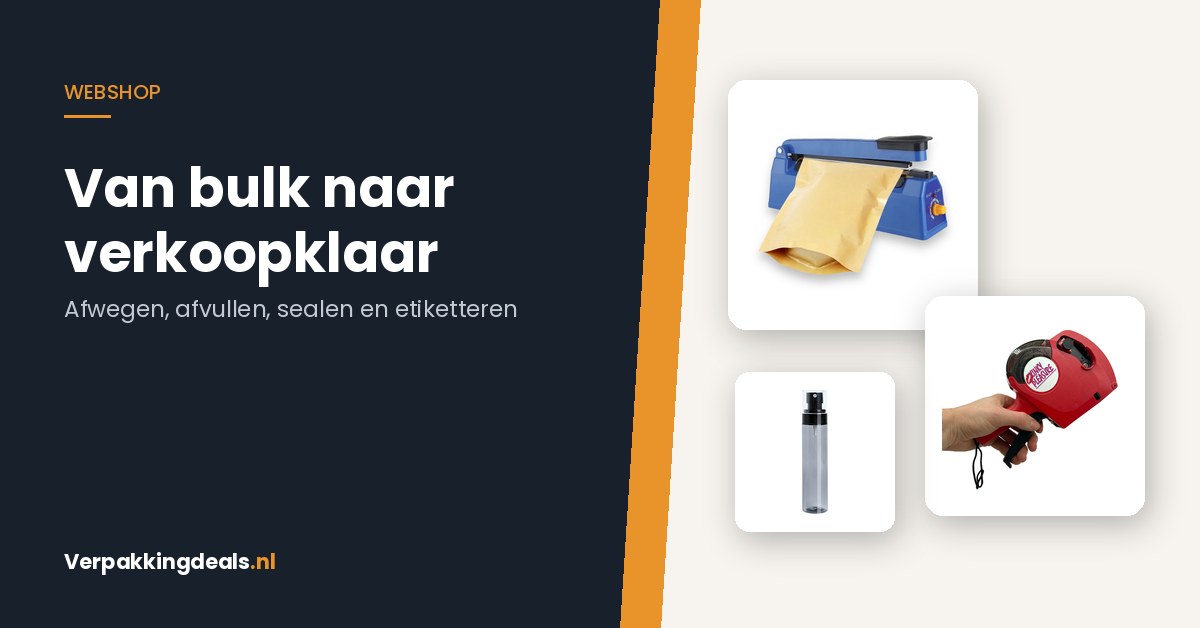
From bulk to retail-ready: weighing, filling, sealing, and labeling
,
by Verpakkingdeals.nl
6 min reading time
Buying in bulk and selling per unit sounds simple, but it hinges on order and tools. Step by step: determine the sales unit, weigh, fill, seal, and label — including what each step costs.
You buy a kilogram of something and sell it in 50-gram portions. Or you get five liters of cleaning solution and repackage it into 120 ml bottles. On paper, that's the simplest margin there is: you pay the bulk price and sell at the unit price. In practice, someone spends an hour spilling at the kitchen table with scales that aren't accurate enough and bags that open again after two days.
Repackaging from bulk to retail-ready units is perfectly feasible, but it hinges on the sequence and the tools. Below are the steps, along with what each step costs in practice.
First determine your sales unit, then your packaging
The sequence that most often goes wrong: people first buy bags or bottles and then decide how much should go into them. Do it the other way around. Choose a unit that is logical for the customer — 50 grams, 100 ml, 10 pieces — and then find packaging that is slightly larger.
Slightly larger is important. A bag filled to the brim cannot be properly sealed: at least an inch and a half of clean film must remain free above the contents. The same applies to bottles: if you fill to the neck, it will overflow as soon as someone twists on the cap.
Weighing or counting — and why you shouldn't guess
If you sell by weight, you need scales that measure smaller than your tolerances. Kitchen scales that jump by the gram are too coarse if you're making 20-gram units: you will consistently give too much or too little. A mini precision pocket scale (from €12.00) is sufficient for that kind of work and fits in a drawer.
Practical method: tare the scales with an empty bag or bottle on them, so you only weigh the contents. Weigh the first five units and note whether you are over or under. Then correct once, and not for each unit again — that's where most time is lost.
If you sell by piece, count in fixed groups of five or ten instead of counting up to your total. This reduces errors and allows you to be interrupted without having to start over.
Filling: dry is different from liquid
Scoop dry products with a measuring spoon or funnel. Liquids are trickier because the neck of a bottle is usually narrower than the pouring spout of your supply bottle. A set of 10 mini funnels (from €9.95) solves this — and ten pieces is not an overkill: you want a separate funnel for each product, so you don't have to rinse and dry in between.
For small quantities, pipettes or tubes work better than pouring. Transparent plastic tubes of 0.5 ml (20 pieces, from €8.00) are intended for samples and very small portions.
For the bottles themselves, the choice depends on what goes in and how the customer uses it:
Pressing a zip-lock bag shut is not the same as sealing. During shipping, a zip closure can open due to pressure, and the customer cannot see if someone has already opened the bag. A heat seal can prevent this.
A manual heat sealer machine (from €79.95) is an investment that pays for itself in one season if you work with dozens of units per week. When using it, pay attention to three things: the film must be clean and dry at the seam, you hold the bar closed for a moment longer than you think necessary, and you check the first seam by pulling it firmly.
Over time, the sealing bar gets covered with caked-on film. Heat-resistant PTFE tape with adhesive (10 meters, from €19.95) is for this: you cover the bar with it, the film no longer sticks, and you replace the strip when it wears out.
If you sell in boxes instead of bags, a seal does the same job. Security seals with VOID effect (60 pieces, from €9.95) leave a visible trace as soon as someone removes them.
Labeling and pricing
On each unit, include at least: what it is, how much it contains, and its own code or batch number. The latter costs nothing and helps enormously if one batch ever turns out to be faulty — then you know which units came from the same bulk.
You repackage too early. Converting everything at once feels efficient, but then you're stuck with a hundred units, maybe twenty of which sell. Work in batches that you can sell within a few weeks — especially for products with an expiration date.
You forget the space around you. Filling on the same table where you pack means you'll get powder or liquid on your shipping boxes. Do it in a separate place, or at fixed times.
You don't account for your own time. If repackaging costs you twenty minutes per batch, that should be reflected in your price. Set that time once with a clock next to you and calculate it.
You don't pay attention to the rules for your product. For food, cosmetics, and chemical products, there are requirements for materials, labeling, and shelf-life indications. If you sell such products, check beforehand what applies to your category with an official source such as ondernemersplein.overheid.nl, and do not repackage anything for which you do not know the requirements.
Choosing a USB hub for working from home: 2.0 or 3.0, how many ports, and with switches
· 3 min reading time
Choosing a USB hub for working from home: 2.0 or 3.0, how many ports and with switchesYour desk needs three USB devices, but your laptop only has two ports. Or...
Power outages in autumn: emergency supplies you'll actually use
· 2 min reading time
Autumn Power Outages: Emergency Supplies You'll Actually Use October to December. Heating isn't in full swing yet, but the nights are getting long and cold. If a power outage strikes...
Choosing a power bank: capacity, charging speed, and weight compared
· 2 min reading time
Choosing a Power Bank: Capacity, Charging Speed, and Weight Compared Your phone dies when you're out and about. The classic emergency solution is a power bank. But what capacity do...