Is this box food-safe? How to recognise food-grade packaging
,
by Verpakkingdeals.nl
6 min reading time
A jewellery box is different from a cake box. Here's how to recognise food-safe packaging, and what to look for in each material before you order a large quantity.
You've purchased a hundred boxes for treats, your stall, or your counter. They're the right size, they look good, and they're inexpensive. Then someone puts a brownie in one and asks: is it actually safe to eat something from a box like this? That's a valid question, and the answer is less obvious than it seems. A cardboard box for a necklace and a cardboard box for a slice of pizza look similar, but they aren't subject to the same rules.
This article explains which rules apply to packaging that comes into contact with food, what to look for in cardboard, plastic, silicone, and bamboo, and how to practically apply this when packaging treats, running a market stall, or operating an online store.
Why "a box is a box" isn't accurate
Everything that touches your food releases small amounts of substances into that food. For a material that has been specifically designed and tested for this purpose, these amounts remain within established limits. For a material not intended for this – a gift box with a painted interior, a decorative pot, a display – this simply hasn't been investigated. No one knows what happens when a warm, greasy, or moist treat is placed inside.
That's the core: it's not about how clean or new something is, but what the material is made and tested for. Packaging used for food is officially called a food contact material. This includes cups, boxes, bags, straws, cutlery, cutting boards, foil, and storage jars.
The rules in brief
The basics are laid out in European legislation. According to the NVWA (Netherlands Food and Consumer Product Safety Authority), Regulation (EC) 1935/2004 sets the general requirements for materials and articles intended to come into contact with food. For plastics, this is further elaborated in Regulation (EC) No 10/2011. In the Netherlands, the Warenwetbesluit verpakkingen- en gebruiksartikelen (Commodities Act Decree on Packaging and Utensils) and its associated regulations also apply.
Two aspects from these are practically relevant for a small vendor or organizer:
For some materials, such as plastics and ceramics, a declaration of conformity is required. This is a document from the producer or supplier stating that the material meets the requirements. If you sell packaged food yourself, this is the document you should request.
For recycled plastic intended for food contact, it must be recycled through an EU-authorized process and meet the same requirements as non-recycled material. So, "recycled" is not automatically the same as "food-safe."
On packaging intended for foodstuffs, you often find the glass-and-fork symbol or the text "food safe." If you want to know exactly which markings are mandatory when and what is required of you as a seller or importer, please consult the NVWA website on food contact materials. If you're unsure about a specific item, ask your supplier before ordering a large quantity.
What to look for per material
Not every material behaves the same way. Manufacturers test with different types of food – dry, moist, acidic, and fatty – because the material reacts differently to each type. A box that is perfectly fine for dry cookies is not automatically suitable for something greasy or warm.
Material
What to look for
Commonly used for
Cardboard and paper
Coating or laminate on the inside, ink on the outside, or if it's grease-proof
Treat boxes, pizza boxes, bags
Plastic
Declaration of conformity, temperature resistance, suitability for fat or not
Cups, lids, containers, straws
Silicone
Temperature range, odor after first use, whether it retains its shape
Baking and ice molds
Stainless steel and glass
Usually insensitive, pay attention to sharp edges and cracks
Cutlery, pots, glasses
Bamboo and wood
Surface treatment, moisture absorption, whether it is single-use or reusable
Straws, skewers, cutlery
Practical: treats, market stall, and webshop
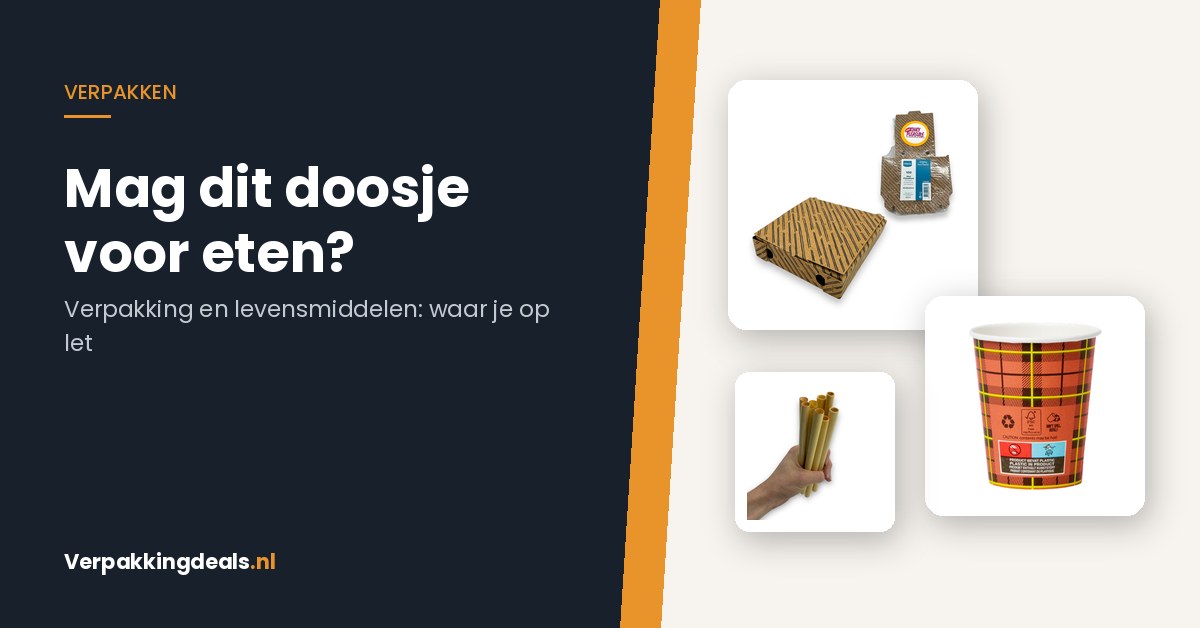
For a treat in the classroom or a stall at a fair, it's simplest to choose packaging that is intended for food and drinks from the outset, rather than repurposing a gift box. Here are a few examples from our range:
If you're filling something yourself - syrup, candy, spices - there's another step: the tools also touch the product. A set of 10 Mini Funnels (€ 9.95) saves mess, and with Empty Bottles 100 ml, 16 pieces (€ 19.95) you can divide a large bottle into portions. If you're working with a product you eat or drink, check beforehand whether the bottles and funnels are intended for that purpose.
Will the product actually touch the food? An outer box containing a sealed bag is different from a box where the cookie lies loose.
Is it dry, moist, acidic, or fatty? Chocolate and pastries are fattier than you might think.
Will it get warm? Hot drinks and freshly baked products have different requirements.
Single-use or reusable? Reusable also means: cleaning, and thus resistant to water and soap.
Can the supplier substantiate it? For plastic and ceramics, there is a declaration of conformity.
In short
Choose packaging that is intended for food from the outset, look beyond the shape and price, and match the material to what will be put in it: dry, greasy, warm, or wet. If in doubt about a large quantity, ask instead of guessing – it takes one email and prevents you from having a hundred boxes that you can't use.
Get started yourself
For your treat, stall, or counter, check out our Food & Drink Accessories, Straws in paper, bamboo, and plastic, Kitchen Utensils, and the complete Packaging & Shipping category for boxes, bags, and void fill. Not sure if a particular item is suitable for what you want to put in it, or need larger quantities? Feel free to email us at info@verpakkingdeals.nl – and we'll figure it out for you before you order.
Choosing a USB hub for working from home: 2.0 or 3.0, how many ports, and with switches
· 3 min reading time
Choosing a USB hub for working from home: 2.0 or 3.0, how many ports and with switchesYour desk needs three USB devices, but your laptop only has two ports. Or...
Power outages in autumn: emergency supplies you'll actually use
· 2 min reading time
Autumn Power Outages: Emergency Supplies You'll Actually Use October to December. Heating isn't in full swing yet, but the nights are getting long and cold. If a power outage strikes...
Choosing a power bank: capacity, charging speed, and weight compared
· 2 min reading time
Choosing a Power Bank: Capacity, Charging Speed, and Weight Compared Your phone dies when you're out and about. The classic emergency solution is a power bank. But what capacity do...